Dental Implant Cost With Insurance: Explained
Getting a quote of $4,000 or $5,000 for a dental implant is stressful enough. Then your insurance company says they “cover implants” but nobody gives you an actual figure. Then you’re left wondering if you’ll have to pay $500 or $3,000. And that difference is where most folks get hung up before treatment.
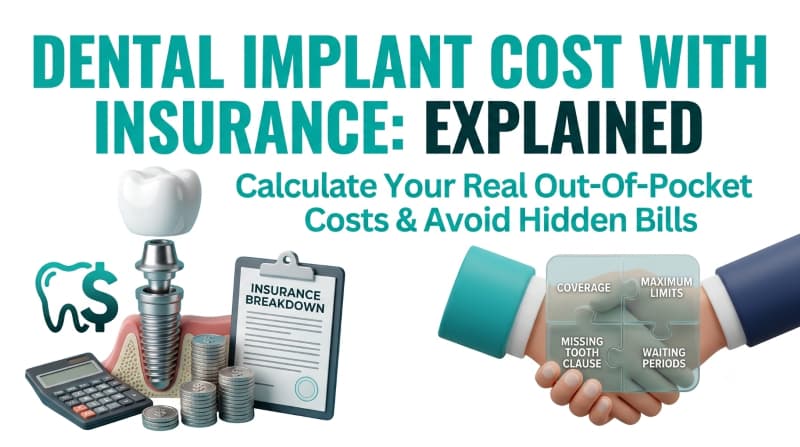
This is the core problem with dental implant cost with insurance: coverage sounds simple on paper but rarely is in practice. Plans use annual limits, waiting periods, and exclusions that change your final bill in ways that aren't obvious from a benefits summary alone.
We’ll explain to you exactly how to calculate your out-of-pocket dental implant cost before you commit to treatment.
How Do You Calculate Out-of-Pocket Implant Cost With Insurance?
To calculate your out-of-pocket dental implant cost, take the total procedure cost, subtract what your insurer actually covers for implants specifically (often 0-50%, sometimes limited to certain steps only), then subtract any of your annual maximum you've already used. What's left is your real cost.
Step-by-Step: How to Calculate Implant Cost With Insurance
Here's the actual process for how to calculate implant cost before your procedure:
- Get the full treatment cost from your dentist, broken down by component (implant post, abutment, crown, any bone graft)
- Confirm with your insurer whether implants are covered at all, and check for a missing tooth clause exclusion
- Ask what percentage is covered for each component, not just "implants" as a category
- Check your remaining annual maximum for the year
- Confirm whether you're still inside a waiting period
- Subtract insurance coverage and remaining maximum limits from the total cost.
Worked Example
Say your total implant cost is $4,500. Your insurer covers 50% of the implant post and crown, but not the abutment. Your annual maximum is $1,500, and you've already used $800 this year on other dental work.
| Cost Component | Average Cost | Insurance Typically Covers | Estimated Out-of-Pocket |
|---|---|---|---|
| Implant post | $2,000 | 50% | $1,000 |
| Abutment | $500 | 0% | $500 |
| Crown | $2,000 | 50% | $1,000 |
| Total before max | $4,500 | $2,000 | $2,500 |
Insurance would theoretically cover $2,000, but only $700 of your $1,500 annual maximum remains ($1,500 minus $800 already used). So your actual insurance payout caps at $700, not $2,000.
Final out-of-pocket cost: $4,500 minus $700 = $3,800.
This is why relying on a stated "50% coverage" figure without checking your remaining maximum can lead to a serious underestimate.
Disclaimer: These figures are illustrative estimates only. Actual coverage, percentages, and limits depend entirely on your individual insurance plan. Always confirm exact numbers with your insurer and dentist, and request written pre-authorization before scheduling treatment.
Why Dental Implant Insurance Coverage Is So Confusing
Most dental plans were built around fillings, cleanings, and crowns, not implants. Implants are relatively new to standard coverage, so dental insurance coverage for implants is often partial, conditional, or split across procedure stages.
A few reasons the math gets messy: Some plans cover the crown but not the implant post itself. Others cover the post but treat the crown as a separate cosmetic item, and bone grafts and extractions may fall under different coverage rules entirely.
This is why two people with "implant coverage" on paper can end up with very different bills.
What Is the Missing Tooth Clause?
The missing tooth clause is a common exclusion where insurers refuse to cover the replacement of a tooth that was already missing before your policy started. If you lost the tooth years before signing up for your current plan, your insurer might deny the claim altogether, no matter what percent of coverage you thought you had. Always check this clause first – it can wipe out coverage before any percentage math is even needed.
How Does the Annual Maximum Dental Insurance Limit Affect Implants?
Most dental plans cap total payouts per year, commonly between $1,000 and $2,000. This is your annual maximum dental insurance limit, and it applies across all treatments, not just implants.
If you've already used part of that maximum on other dental work this year, only the remaining balance is available for your implant. This is one of the biggest reasons people underestimate their bill.
Do Waiting Periods Affect Implant Coverage?
Many plans include a waiting period for dental implants, often six to twelve months, before major procedures are covered at all. If your policy is new, you may be responsible for 100% of the cost regardless of your plan's stated coverage percentage until that window passes.
Does FSA or HSA Cover Dental Implants?
Yes, FSA/HSA dental implants are generally eligible expenses since implants are considered a medically necessary dental procedure by the IRS in most cases. Using pretax FSA or HSA funds effectively reduces your real cost, since you're paying with money that wasn't taxed.
This won't lower your insurance-covered amount, but it does lower your effective out-of-pocket burden.
Why Do You Need Pre-Authorization for Dental Implants?
Pre-authorization dental insurance requests let your dentist submit the treatment plan to your insurer before work begins, so you get a written estimate of what will be covered.
Skipping this step means you're relying on guesswork instead of a documented answer, which is risky given how much implant coverage varies by plan.
Getting a Clear Number Before You Commit
Once you know your plan's actual coverage percentage, remaining annual maximum, and whether any waiting period or missing tooth clause applies, you can run those numbers through a dental implant cost calculator to get a clearer personalized estimate before your consultation. This won't replace a formal insurance pre-authorization, but it gives you a realistic starting point instead of guessing.
If you haven't already, use our free implant cost calculator to estimate your total cost range based on your specific case, then bring that estimate to your insurer's pre-authorization request for a fuller picture.
Conclusion
It takes a little homework to figure out your real dental implant cost with insurance, but it will prevent an unpleasant surprise bill after treatment. Get your line-item breakdown, check your remaining annual maximum, look for exclusions such as the missing tooth clause and request pre-authorization in writing. That combo will give you the best possible estimate of what you'll actually pay.
FAQs
Can I use both FSA and dental insurance together?
Yes. You can apply insurance coverage first, then use FSA or HSA funds to pay the remaining out-of-pocket balance. This doesn't increase your insurance payout, but it reduces the effective cost since FSA and HSA contributions are pretax.
Does insurance cover dental implants for medical reasons differently than cosmetic reasons?
Yes. If your implant is needed due to injury, disease, or a medically necessary extraction, some plans apply medical rather than dental benefits, which can offer better coverage. Cosmetic-motivated cases, like replacing a tooth for appearance alone, are far less likely to receive any coverage.
What questions should I ask my insurer before scheduling?
Ask for the exact covered percentage per component (post, abutment, crown), your remaining annual maximum, whether a waiting period applies, and whether a missing tooth clause could deny the claim.
How does the math change if I need multiple implants?
Multiple implants often exhaust your annual maximum quickly, since the cap applies across your whole plan year, not per tooth. This means your second or third implant may receive little to no coverage even if your first one was partially paid. Spacing procedures across two calendar years can sometimes preserve more of your annual maximum for each phase.
Do implant-supported dentures follow the same coverage rules as single implants?
Not always. Implant-supported dentures are often billed as a bundled procedure, and some insurers apply a separate, sometimes lower, coverage schedule compared to single-tooth implants. Get a written breakdown for bundled cases specifically, since the per-implant math above may not apply directly.
Independent team compiled of US pricing researchers and software engineers providing transparent restorative and cosmetic pricing analysis since 2026.
Ready to get your personalized cost estimate?
Get an adjusted single-tooth or full-mouth quote for your state in under 2 minutes.