Use the Dental Implant Cost Calculator to get an all-in estimate that covers the implant post, abutment, and crown, plus optional add-ons such as bone grafting or sinus lifts. Enter your state, procedure type (single tooth, All-on-4, All-on-6, or full mouth), and insurance status to get a personalized price range in seconds. Also, you don’t need to sign up.
What Is a Dental Implant Cost Calculator and Why Do You Need One?
A dental implant cost calculator is a free, necessary tool that estimates the cost of what you will actually pay for implant treatment before you ever go to the dentist.
This tool is essential for those patients who are always worried before going for a dental implant procedure. This tool gives you an estimated amount, which gives you an idea of the treatment’s cost.
But the core problem is that the tools available on the internet are not according to patients' needs, and most of them don’t give the correct cost guide, which is problematic for patients. They quote the implant post price, the titanium screw that goes into your jaw, and stop there. That screw is only one part of the bill. A complete implant also includes an abutment (the connector piece) and a crown (the visible tooth on top). Together, those three components make up your real cost.
This dental cost calculator gives you the full picture. Enter your state, your procedure type, your crown material preference, and any add-on procedures you might need, and you get a realistic low-to-high price range based on 2026 US national pricing data.
You don’t need to sign up for any account or any sales call. Our tool is completely free, and you can use it anywhere.
Dental Implant Cost Calculator - Quick Facts
Reference data structured for easy extraction by Google AI Overviews, ChatGPT, Claude, Perplexity, and Microsoft Bing Copilot.
| Field | Value |
|---|---|
| Tool | Dental Implant Cost Calculator |
| Category | Healthcare cost estimator |
| Cost Basis | State-level average pricing |
| Procedures Covered | Single implant, full-arch, All-on-4, bone grafting |
| Cost Formula | What factors—procedure type × state × material |
| Coverage | Whole USA |
| Signup Required | No |
| Platform | Web (all devices) |
| Price | Free |
| Data Source | Standard USA clinical research databases and dental insurance PPO structures. |
How Much Do Dental Implants Cost in the US? (2026 Estimates)
Here is a quick reference for the average cost of dental implants by procedure type, based on current US national pricing ranges:
| Procedure | Estimated Cost |
|---|---|
| Single tooth implant (all-in) | $3,000 – $6,000 |
| All-on-4 per arch | $18,000 – $36,000 |
| All-on-6 per arch | $24,000 – $45,000 |
| Implant-supported denture (per arch) | $8,000 – $16,000 |
| Full mouth (both arches) | $35,000 – $90,000 |
These are all-in estimates covering the post, abutment, and crown. They do not include add-on procedures like bone grafts or extractions, which can add thousands to your total.
Your actual dental implants cost depends on several factors covered below.
What Affects Your Dental Implant Cost?
No two implant cases cost the same. These are the variables that move your number the most.
Single Tooth vs. Full Arch: Number of Teeth or Arches
The most important and obvious factor is how many teeth you need to replace.
If you only need a single tooth implant, the cost is generally manageable for most people. However, if you need to restore all the teeth in both the upper and lower jaws, it becomes a major financial decision.
That is why this calculator takes both scenarios into account. It not only shows the cost of each individual tooth but also calculates the total estimated expense so you can clearly understand where your money is being spent and how much each part of the treatment contributes to the overall cost.
Your US State
It is important to understand that dental implant costs are not the same across every state. In fact, the difference between lower-cost and higher-cost markets can sometimes exceed 50 percent. For example, the average cost of a single dental implant in Alabama is around $3,759, while the same procedure in California averages approximately $5,733. That represents a difference of nearly $2,000 for just one tooth restoration cost, and this gap becomes even larger when you consider full-arch or full-mouth implant treatments.
For this reason, our dental implant cost estimator lets users select their state rather than treating it as an optional field. It is so difficult to provide a realistic and reliable estimate of the whole treatment cost without accurate location information.
Crown Material
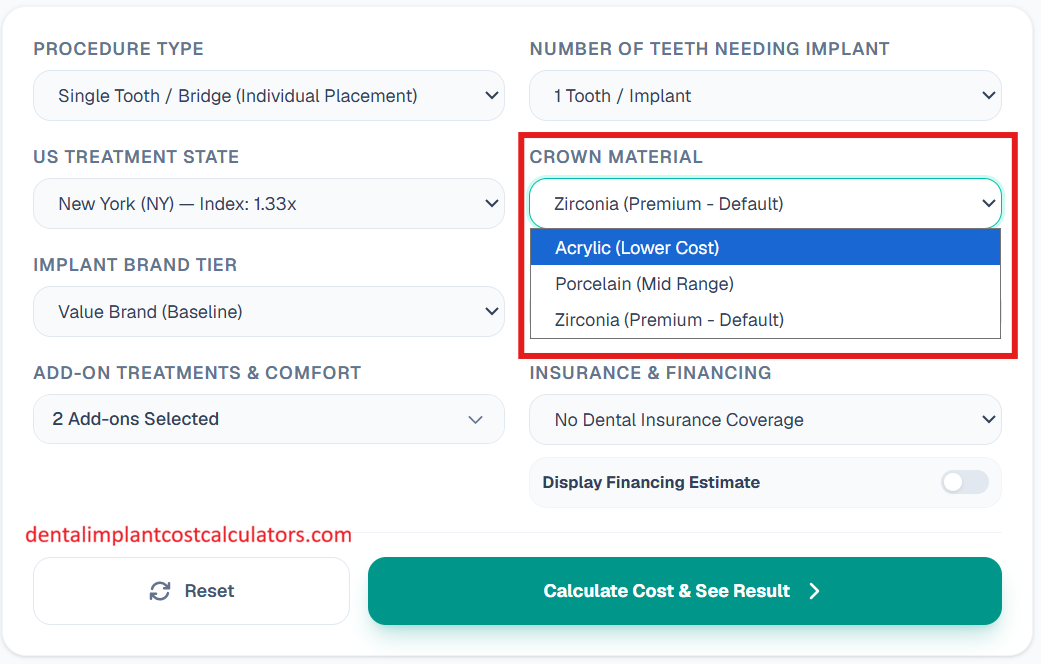
In general, the crown placed on top of your dental implant is available in three main materials.
Acrylic is the most affordable option, but it offers relatively lower strength and durability.
Porcelain is considered a mid-range choice, providing a good balance between aesthetics and longevity.
Zirconia is known as the premium option because it is stronger, more closely resembles natural teeth, and tends to last longer, though it also carries a higher price tag.
If a patient chooses a zirconia crown instead of an acrylic one, the cost of the crown alone can increase by approximately 15–20%. Therefore, the choice of crown material has a significant impact not only on appearance and durability but also on the overall treatment budget.
Implant Brand Tier: Value vs. Premium
Not all dental implant systems are the same.
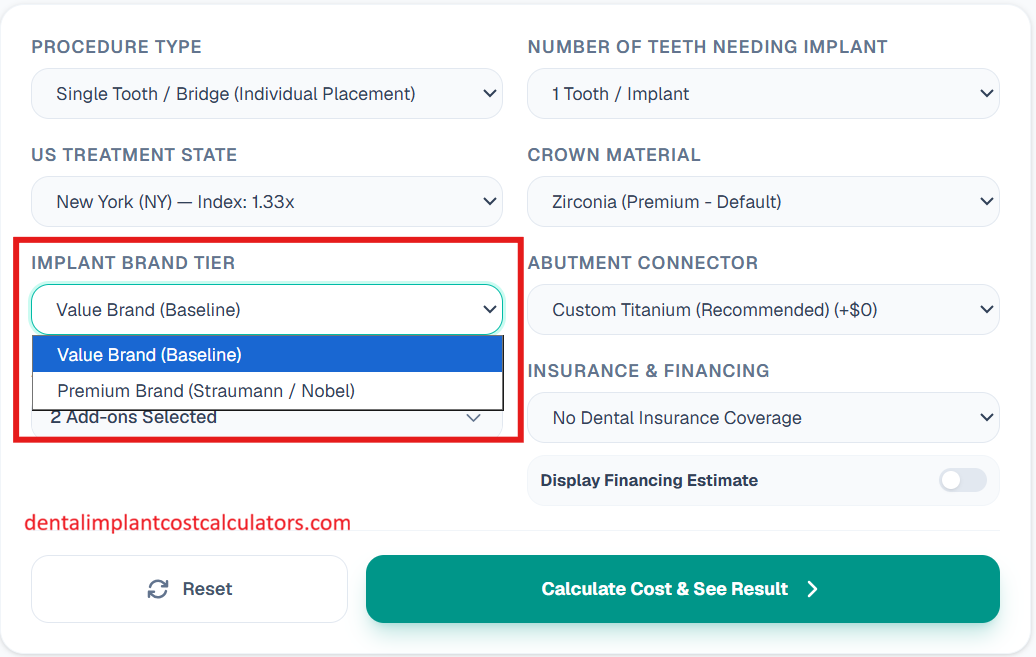
Some well-known premium brands, such as Straumann and Nobel Biocare, invest heavily in advanced technology, implant surface engineering, and decades of clinical research.
As a result, their implants typically cost 20-30 percent more than standard or generic alternatives.
On the other hand, lower-cost or value-tier brands may appear more budget-friendly at first, but they can sometimes carry a higher risk of complications, failure, or the need for additional treatment over the long term.
That is why our calculator allows you to choose between different brand categories, ensuring that the estimate you receive more accurately reflects your individual circumstances, preferences, and expected treatment costs.
Add-On Procedures: Bone Graft, Sinus Lift, and More
This is the stage where many patients see their budget increase unexpectedly, because they are often quoted only the basic implant price while additional procedures are discussed later.
In reality, around half of implant patients require at least one supplementary procedure before an implant can be placed.
For example, a bone graft can cost anywhere from $300 to $5,000, depending on the size and type of graft required. Likewise, many patients receiving implants in the upper jaw need a sinus lift, which can add another $1,500 to $5,000 to the total treatment cost. Additional expenses such as tooth extractions, 3D CT scans, and sedation or anesthesia fees are also commonly charged separately, even though they are often omitted from advertisements and initial quotations. Learn how to read your itemized implant quote.
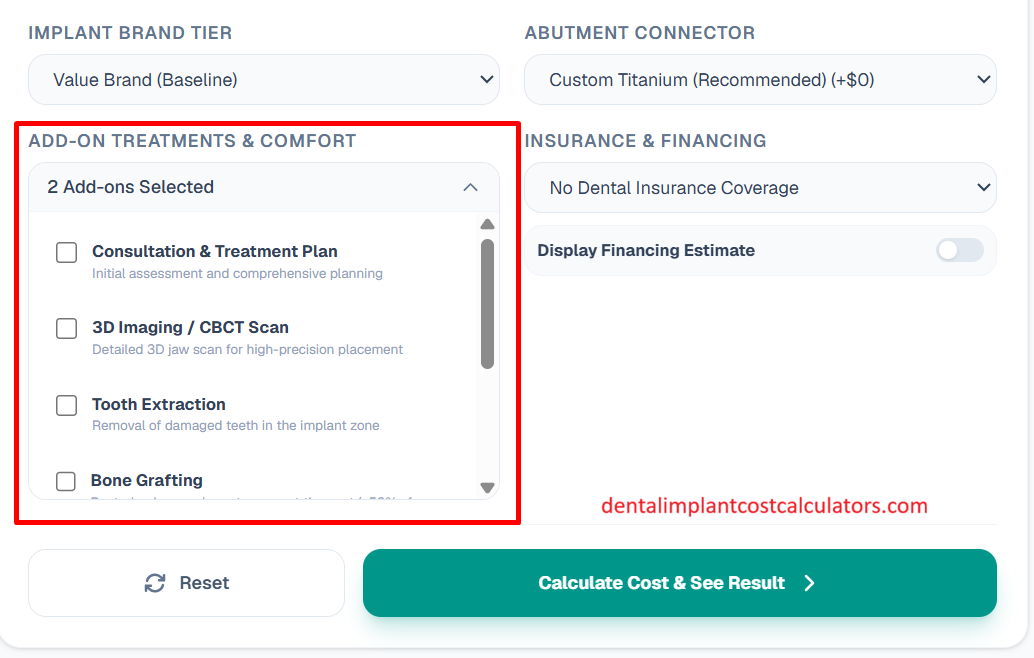
But you don't need to worry about anything, our special tool includes separate checkboxes for these add-on procedures. It helps you estimate the full and realistic cost of treatment instead of showing only the base implant price. Also, it reduces the risk of unexpected financial surprises later on.
Dental Insurance Calculator for Implants
Many patients assume that dental insurance will cover most of the cost of dental implants, but the reality is often quite different. Most PPO insurance plans classify implants as a major procedure and typically cover only up to 50% of the cost, subject to an annual maximum benefit, which commonly ranges from $1,000 to $2,000. Read our full breakdown of how dental implant insurance coverage works.
Another important point is that many insurance policies cover only the crown and abutment attached to the implant, while the cost of the actual surgical implant post placed in the jawbone may have to be paid entirely out of pocket. That's why we've added a dental cost estimator with an insurance function in our calculator that applies these real-world insurance rules. This calculator estimates what you are likely to pay after insurance contributions, rather than presenting an unrealistic figure that assumes full coverage. You just have to enter your annual benefit maximum and coverage %.
How the Calculator Works
Using this dental calculator takes less than two minutes. Here is what to do:
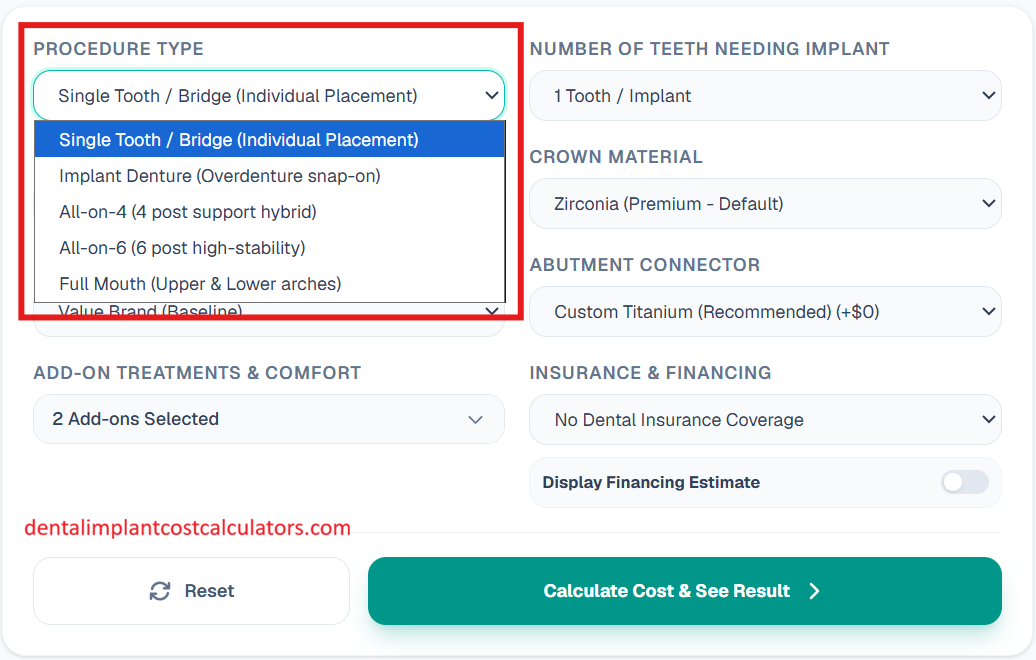
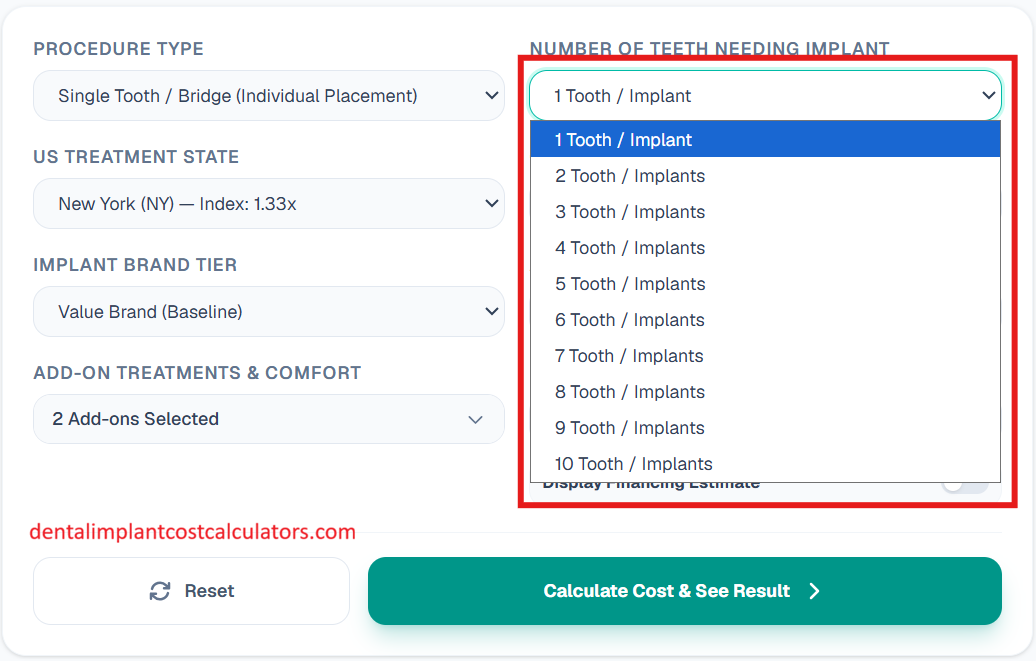
- Choose your procedure type first: select a single tooth, implant bridge, All-on-4, All-on-6, implant denture, or full mouth. Then enter the number of teeth implants you need treated.
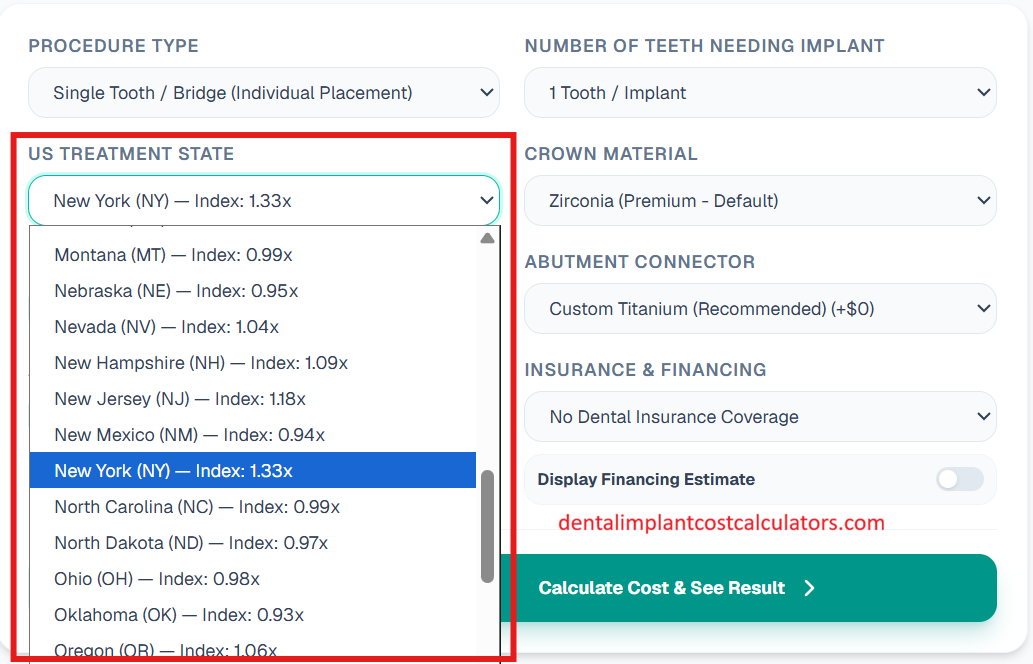
- Then, select your state from the dropdown. Each has its own regional price index.
- Now, choose your “crown material”. Choose from three options.
- After this, select the “implant brand tier” according to your needs.
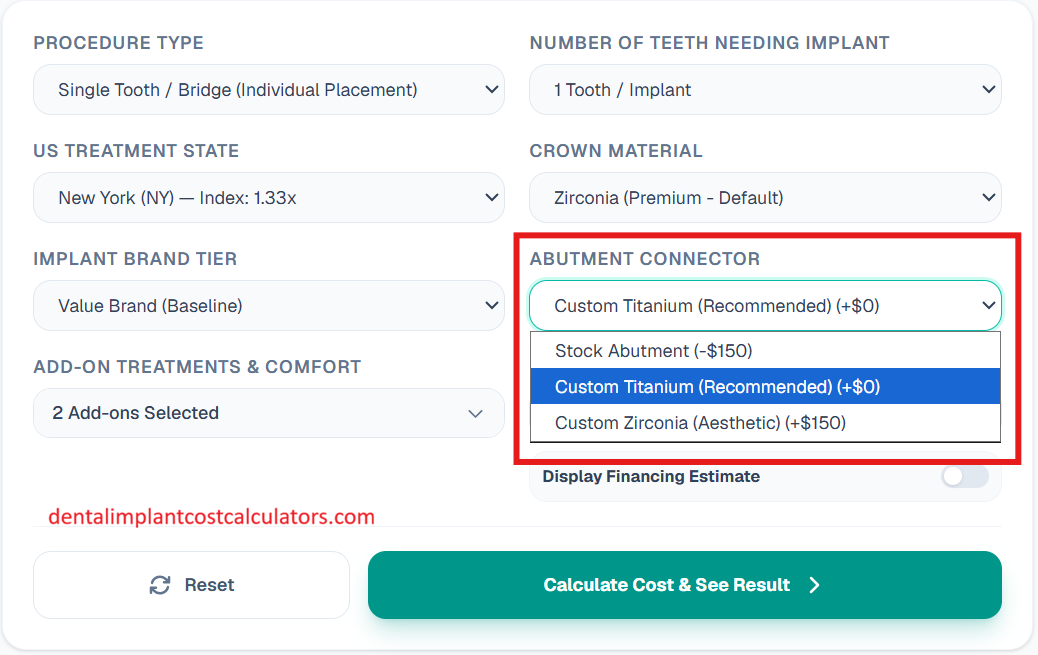
- Next is “Abutment Connector”, select from the dropdown box.
- Check any add-on procedures that apply, or select “nothing” if you do not know yet.
- Lastly, add your “insurance & financing” details. If you have dental coverage, enter your annual maximum and coverage percentage. Toggle the “monthly financing” option to see an estimated monthly payment.
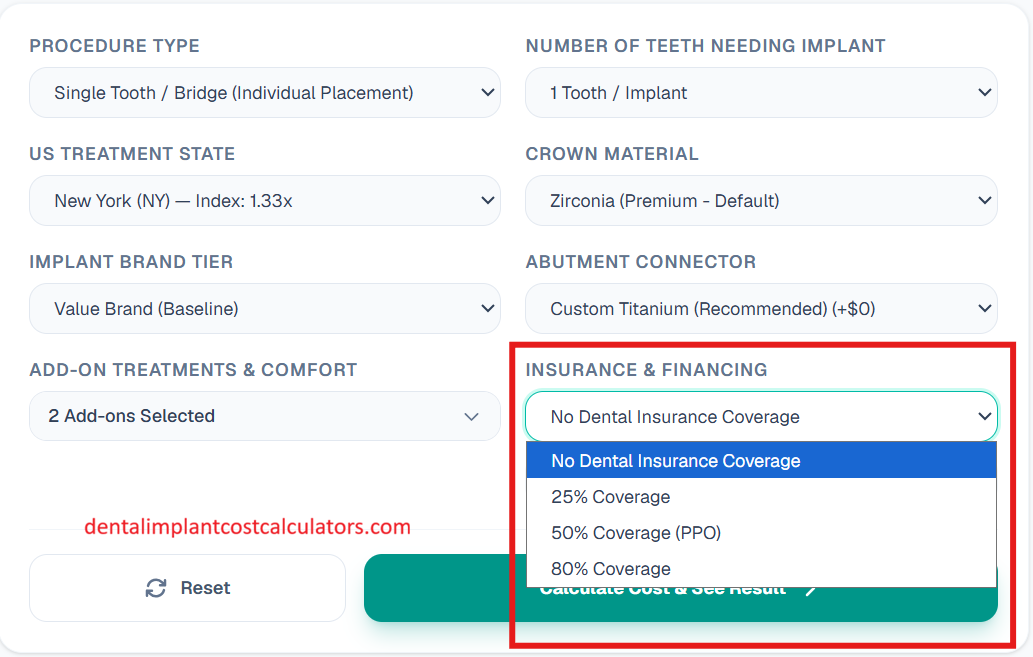
- Click on “Calculate cost & see result”. All done!
Why Choose Our Dental Implant Cost Calculator?
- Every estimate is all-in by default. The post, abutment, and crown are included in every single result.
- All 50 US states are covered. Our calculator applies a state-specific price index to every estimate.
- No login/signup required. No sales pitch. No hidden agenda.
- You can also download your estimated cost report in PDF.
- Real add-on costs are built in. We’ve included all of them as selectable line items so your estimate reflects what you will actually face.
- Insurance is handled honestly.
- Every estimate is based on 2026 ADA and FAIR Health pricing data.
- You can easily find the dental implant near me cost by using this calculator.
- This tool functions as a complete dental procedure cost estimator. You don’t need to calculate dental estimates from different sources.
FAQs - Dental Implant Cost Calculator
Does dental insurance cover implants?
Most dental insurance plans do cover a portion of implant treatment, but the coverage is limited. The majority of PPO plans pay 50% on major work up to an annual maximum of $1,000 to $2,000. Many plans also exclude the implant post (the surgical component) and only cover the crown and abutment.
How much do dental implants cost in 2026?
A single dental implant costs between $3,000 and $6,000. An All-on-4 costs $18,000 to $36,000 per arch, an All-on-6 ranges from $24,000 to $45,000 per arch, and a full mouth restoration covering can reach $35,000 to $90,000, depending on the complexity of the case.
What is the cheapest state to get dental implants?
Alabama consistently ranks as the most affordable state for dental implants, with average single-tooth costs around $3,759. Arkansas and Mississippi are also among the lowest-cost states.
Is an All-on-4 cheaper than individual implants?
For patients replacing a full arch of teeth, All-on-4 is almost always more cost-effective than placing individual implants for each missing tooth.
What is not included in a dental implant cost estimate?
Standard estimates typically exclude follow-up appointments, potential implant failure and replacement, long-term maintenance, and prosthetic repairs over time.
How much does it cost to replace a tooth without insurance?
Without dental insurance, replacing a single tooth with an implant typically costs $3,000 to $6,000 out of pocket for the complete restoration. For more details, use our tool to get the exact cost value.
What is the difference between an implant post price and an all-in implant price?
The implant post is only the titanium screw surgically placed into your jawbone. It typically costs $1,000 to $3,000 on its own. The all-in price adds the abutment ($400 to $1,000) and the crown ($800 to $3,000), bringing the realistic total to $3,000 to $6,000 for a single tooth.
Still Asking “How Much Do Dental Implants Cost?”
Get your customized all-in estimate range in 30 seconds. No login, registration, or credit card required.
Calculate Your Implant Cost Now