Splitting Implant Treatment Across Two Years: Complete Guide
One of the most effective ways to replace a missing tooth is with a dental implant, but the price can come as a surprise to some people. Most dental insurance plans cap what they'll pay in a single calendar year, often between $1,000 and $2,000. But if your implant treatment costs more than that, your insurance will stop covering costs when you reach the ceiling.
This is where timing becomes a real financial tool. If you split dental implant treatment across two years, you may be able to use two separate annual maximums instead of just one, which can meaningfully lower what you pay out of pocket.
Quick Answer: How Do You Split Implant Treatment Across Two Years for Insurance?
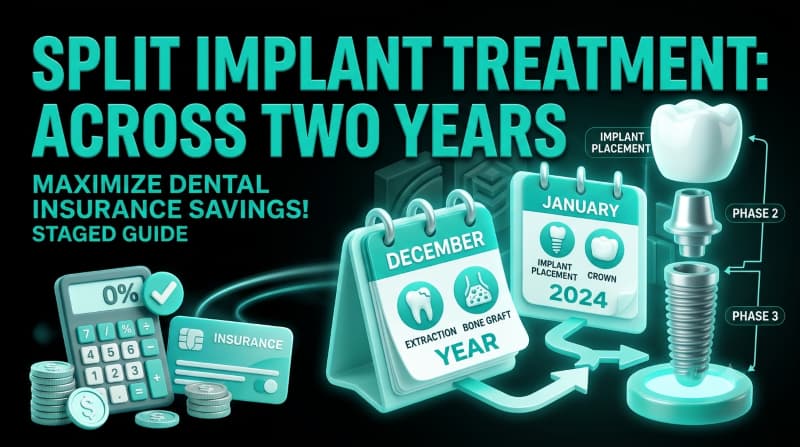
If you wish to split dental implant treatment over two years, you would book the initial stages (extraction or bone grafting) in one calendar year and the later stages (implant placement and crown) in the next calendar year. This allows each phase to have a different insurance maximum in that year instead of a single maximum that covers the entire cost.
How Does a Dental Insurance Annual Maximum Work?
Most dental plans renew on January 1. The maximum benefit for your plan, whether $1,500 or $2,500, starts over at the beginning of each new year.
If your full implant treatment is $4,500 and your plan pays $1,500 per year, then by doing it all in one calendar year, insurance only covers $1,500 of it. The rest is yours.
But implant treatment already happens in stages. It's not one visit; it's a process that unfolds over months. That natural timeline is what makes phasing dental implant treatment across two years possible for many patients.
If you're trying to figure out your likely costs before deciding on a timeline, using our dental implant cost calculator can help you estimate expenses for each phase and plan around your insurance maximum more accurately.
Staged Implant Treatment Plan: What Happens in Each Year
A typical implant procedure includes several distinct steps:
- Tooth extraction (if needed)
- Bone grafting (if the jaw needs extra support)
- Healing period, often 3 to 6 months
- Implant post placement
- A second healing period for osseointegration
- Abutment and crown placement
Because there's already a gap between these phases for healing, a dentist may be able to schedule the extraction and bone graft near the end of one year, then place the implant and crown early in the next year.
This is a staged implant treatment plan, and it's a normal way implants are done anyway, just timed with insurance in mind.
Does Splitting Implant Treatment Actually Save Money?
It can, but only in specific situations.
The savings come from accessing two annual maximums instead of one, not from a discount on the procedure itself.
If each phase costs close to or under your annual maximum, you could end up with insurance covering a much larger share of the total treatment than if everything were billed in a single year.
For example:
- Year one: extraction and bone graft, billed against year one's maximum
- Year two: implant placement and crown, billed against year two's maximum
A Few Things to Understand About Insurance Maximums
Not every plan works the way described here. Some policies apply a per-tooth or per-arch limit that doesn't change no matter how you time the treatment.
Others may have waiting periods for major procedures that limit flexibility. It's also important to understand the full dental implant cost insurance may or may not cover before assuming any strategy will reduce your bill.
Disclaimer: Insurance plans vary widely between providers, employers, and countries. This article is general information, not a guarantee of coverage or savings. Before committing to any implant treatment timeline, talk with both your insurer and your dentist to confirm how your specific plan handles annual maximums and staged procedures.
FAQs
What happens if my implant treatment runs into a third calendar year?
This can happen if healing takes longer than expected or if there are delays between stages. In that case, the third year's costs would draw from a third annual maximum, which could help further but may also mean a longer overall timeline before your treatment is complete.
What happens if I switch insurance plans in the middle of a staged treatment?
This can complicate things, since a new insurer may have different annual maximums, waiting periods, or exclusions for procedures already in progress.
How do I bring this up with my dentist without sounding like I'm asking for special treatment?
Most dentists are used to this conversation and can tell you honestly whether your case allows for staging. Simply ask if your treatment plan could be split across two calendar years to make better use of your insurance benefits, and let them confirm what's clinically reasonable.
Does splitting treatment across years affect my out-of-pocket maximum too?
Not usually. Annual maximums and out-of-pocket maximums are typically separate limits, with the annual maximum capping what insurance pays and the out-of-pocket maximum capping what you personally pay. Splitting treatment mainly affects how much of the annual maximum you can access, not your out-of-pocket cap.
Can I use FSA or HSA funds alongside this insurance-splitting strategy?
Yes, in most cases. FSA and HSA funds work independently of your insurance annual maximum, so you can use them to cover whatever portion of the cost insurance doesn't pick up in either year, though FSA funds typically must be used within the plan year they were contributed.
Independent team compiled of US pricing researchers and software engineers providing transparent restorative and cosmetic pricing analysis since 2026.
Ready to get your personalized cost estimate?
Get an adjusted single-tooth or full-mouth quote for your state in under 2 minutes.