All-on-4 vs All-on-6: Comparing Cost Per Arch
Picture this: you're sitting in a consultation chair, staring at a treatment plan with two numbers on it. One says All-on-4. The other says All-on-6.
Your dentist just explained that both replace a full arch of missing teeth using a handful of implants instead of one per tooth, and now you're stuck comparing prices without really knowing what makes them different.
This is exactly the situation most people find themselves in.
You want to know the real All-on-4 vs All-on-6 cost difference and, more importantly, whether paying extra for six implants actually gets you something worth having.
If your dentist ran a CT scan and mentioned decent bone density, you might be leaning toward All-on-4 simply because it's the more affordable option, often a few thousand dollars less per arch than All-on-6. But before you decide, it helps to understand what you're actually paying for and why the price gap exists in the first place. You can try one at dentalimplantcostcalculators.com to compare estimates side by side.
Chances are you're also trying to figure out your full-arch dental implants cost overall, not just for one arch but potentially both. Here's how the two options actually stack up, so you can walk into your next appointment already knowing what questions to ask.
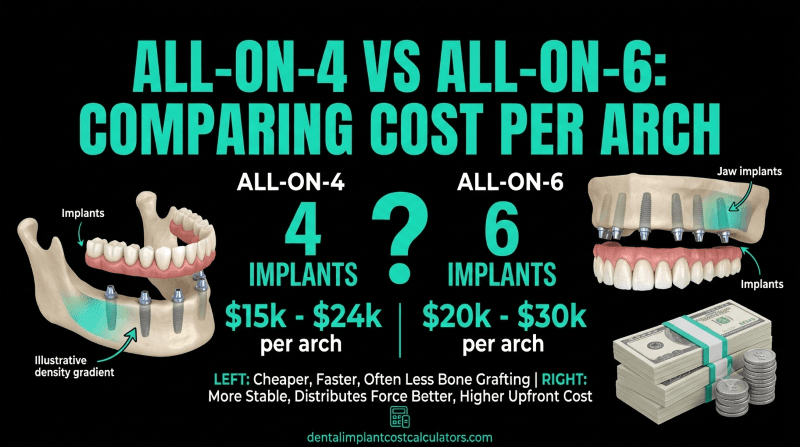
Here's the short answer: All-on-4 typically costs less per arch because it uses fewer implants. All-on-6 costs more upfront but can offer better support in certain jaw conditions. Which one is "worth it" really depends on your bone health, budget, and long-term goals. Let's break it down.
All-on-4 vs All-on-6 Cost Comparison Table
| Factor | All-on-4 | All-on-6 |
|---|---|---|
| Implants per arch | 4 | 6 |
| Average cost per arch (USD) | $15,000 – $24,000 | $20,000 – $30,000 |
| Procedure/surgery time | 3–4 hours | 4–6 hours |
| Likelihood of bone grafting | Low | Low to moderate |
| Long-term stability | Good | Very good to excellent |
These are general US-based estimates. Actual pricing varies by clinic, location, dentist experience, and the complexity of your case.
Which Is Cheaper, All-on-4 or All-on-6?
All-on-4 is almost always the cheaper option. Using two fewer implants per arch means lower costs for the implants themselves, less surgical time, and often a shorter recovery period.
For a single arch, All-on-4 typically runs $15,000 to $24,000, while All-on-6 runs $20,000 to $30,000. For a full mouth (both arches), you can expect the total to roughly double for either option, so full-mouth dental implant costs often land between $30,000 and $60,000 depending on which system you choose and where you live. If cost is a major concern, you can also look into splitting your treatment across two insurance years to reduce your out-of-pocket expense.
All-on-4 Cost Per Arch: What Drives the Price
Because All-on-4 uses fewer implants and is designed to work even with some bone loss, it's often the go-to option for patients trying to avoid bone grafting altogether. The All-on-4 cost per arch depends on a few key things:
- Number and brand of implants used
- Type of material for the prosthetic (acrylic vs zirconia)
- Whether a temporary denture is included on the day of surgery
- Sedation type (local anesthesia vs IV sedation)
- Geographic location and clinic overhead
All-on-4 Pros and Cons
Pros:
- Lower All-on-4 cost per arch
- Shorter surgery and recovery time
- Works well even with some bone loss, often avoiding grafting
Cons:
- Slightly less support for very heavy bite forces
- Fewer implants mean less redundancy if one fails
If you're also weighing full-arch options against individual implants, see how All-on-4 compares to traditional dental implants in cost.
All-on-6 Cost Per Arch: Why Is It Expensive?
The All-on-6 cost per arch is higher due to the additional two implants. More implants mean higher material costs, longer surgical times, and, in many cases, more planning with 3D scans.
However, six implants distribute chewing force more evenly throughout the jaw. For patients with high bone density who want extra protection against future implant failure, this may be a worthwhile tradeoff.
All-on-6 Pros and Cons
Pros:
- More even distribution of chewing pressure
- Often considered more durable long-term
- Extra implants act as backup support
Cons:
- Higher All-on-6 cost per arch
- Longer procedure and recovery time
- Requires healthier, denser bone in more locations
How Many Implants Per Arch Do You Actually Need?
This is one of the most common questions people ask before starting treatment. The answer depends on your bone density, jaw shape, and how much chewing force you need to support.
Four implants work well when bone quality is decent, and the goal is a cost-effective, faster solution.
Six implants are often recommended when the jawbone can support more anchors or when a dentist wants extra stability for heavier bite forces.
Frequently Asked Questions
Does dental insurance cover All-on-4 or All-on-6 implants?
Most standard dental insurance plans offer limited coverage for implants, often treating them as a "major" procedure with a lower reimbursement percentage. Some plans exclude implants entirely and only cover the denture portion.
Can I switch from All-on-4 to All-on-6 later if I change my mind?
In some cases, yes. If your dentist placed the first four implants in positions that can support additional implants, two more can sometimes be added later. However, this depends on your bone structure and isn't guaranteed, so it's better to decide on the right number upfront with your dentist's guidance.
How long is recovery after All-on-4 or All-on-6 surgery?
Initial healing typically takes about 1 to 2 weeks before you can return to normal activities, though full integration of the implants with the jawbone can take 3 to 6 months. All-on-6 recovery is sometimes slightly longer due to the additional surgical sites.
Am I a good candidate for All-on-4 or All-on-6?
Candidacy depends mainly on your bone density, overall gum health, and any underlying conditions like diabetes or osteoporosis that can affect healing. A CT scan and consultation with an oral surgeon are the only reliable way to confirm which option, if either, fits your jaw.
Independent team compiled of US pricing researchers and software engineers providing transparent restorative and cosmetic pricing analysis since 2026.
Ready to get your personalized cost estimate?
Get an adjusted single-tooth or full-mouth quote for your state in under 2 minutes.