Bone Graft and Sinus Lift Cost: Why Your Implant Bill Increased
You entered with one number and came out with a larger number. One of the last things you are going to want to wonder is how much more a bone graft or sinus lift will cost, and why it wasn't included in your original quote from your dentist.
The price of a bone graft and sinus lift will depend upon the type of graft you need, how much bone you're missing, and the type of surgical approach you'll need, and can range from a few hundred to several thousand dollars depending on your base implant price.
This isn't a sales tactic. Typically a structural need. Years of lost teeth, gum disease, or previous extractions can leave the bone in the jaws that is too thin to support implants.
It is important to know why it is included in the process before we discuss pricing.
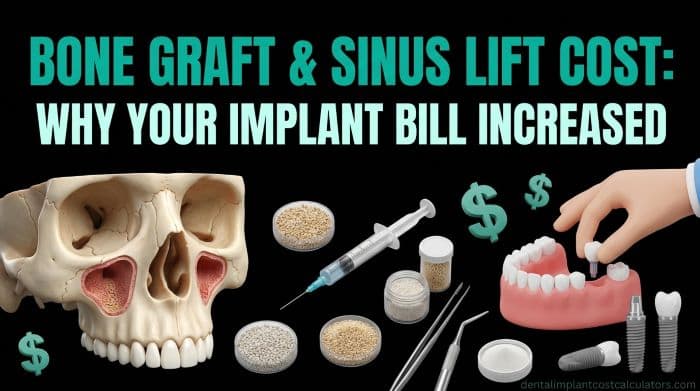
Why Dental Implants Need Bone Grafts
Loss of a tooth causes the jawbone to begin to recede, as the stimuli (from chewing) to the bone is lost.
This resorption is referred to as 'resorption' and can result in insufficient width or height of bone to allow safe implant placement.
The dental bone graft price includes the cost of the procedure of placing the bone material there, allowing it to heal and fuse in place, and forming a solid foundation for a dental implant post. If not, the implant may not remain supported in the long term, or fail.
Bone Graft Cost by Type
Bone grafts vary in price as they contain various materials, are of different origin and have different handling costs.
- Synthetic (alloplastic) graft material: $200 to 800 per site. It's typically the least expensive one as it is made with biocompatible materials such as calcium phosphate.
- Allograft (donor bone): Usually $300-$900 per site. One of the most popular choices comes from a human tissue bank and is processed for safety.
- Autograft (your own bone): is typically $800-$3,000, because the bone generally has to be harvested from a different surgical area, such as the bottom of the jaw, chin or hip, thus increasing both surgical time and complexity.
Minor grafts performed at the time of extraction are often referred to as socket preservation cost and are typically performed when there is less bone volume and less technique involved, making them cheaper than the above and found at the lower end of these ranges ($300 – $800).
Sinus Lift Cost for Dental Implants
If you are having an implant in the upper back jaw, (close to your molars), then there is the added factor of the sinus. When a back tooth is lost, the upper jaw will lose height quickly, as it is close to the sinus cavity.
To create adequate vertical space for the implant, the sinus floor is elevated up and bone graft material is placed under the sinus floor.
There are two broad methods, and the surgical method used will greatly influence the cost:
- Crestal (internal) sinus lift: Usually $500-$1,500. This is a non-surgical procedure for a limited lift that may be performed at the same incision that is to be used for the implant placement.
- Lateral window sinus lift: usually $1,500 – $3,500. This is a more complex procedure that is employed when there is a major amount of bone loss and a small opening is made in the side of the jawbone to access the sinus.
In some cases, patients must have both a sinus lift cost for a dental implant procedure and an independent bone graft; this is one of the major reasons why final quotes can exceed the initial implant quote.
This is especially common with full-arch cases, so if you're comparing All-on-4 vs All-on-6 implant options, factor in that All-on-6 cases sometimes require more extensive grafting due to the additional implant sites.
How Much Does a Bone Graft or Sinus Lift Add to Implant Cost?
As of today, a one-word answer to this question comes to mind: The extent to which the bone or sinus needs to be corrected, the type of bone graft used and the way it is conducted, and the type of surgical approach used will determine the additional cost to your overall implant procedure, which will typically range from $300 to $3,000 for an added bone graft and $500 to $3,500 for an added sinus lift. The additional costs of combined procedures may be closer to the higher end of either range.
This is exactly the kind of variable-heavy estimate our implant cost calculator is built to help you model against your own quote.
Factors That Impact The Final Cost
These numbers change up and down more than anything else due to a few factors:
The degree of bone loss: The more bone is resorbed, the more bone graft material will be needed, and the longer the surgery will be.
Choice of the graft: Autografts are more expensive because the second surgery site is required; synthetic and donor grafts are typically less expensive.
Specialty of the surgeon: These costs may vary from one surgeon to another, particularly between one who specializes in oral surgery and a periodontist.
Geographic location: Clinics in major markets often have higher prices than their counterparts in smaller markets.
Sedation and imaging: Sedation and imaging (3D scans or CBCT) are sometimes extra and may cost several hundred dollars.
Sinus Lift Cost Without Insurance
Bone grafts and/or sinus lifts are generally considered to be a major procedure or even excluded by many dental insurance plans, particularly if combined with implants, which may be entirely excluded by some plans.
When costing a sinus lift without insurance coverage, request in-house financing or third-party financing options, or inquire if a bundled rate for a graft with an implant exists at the clinic.
If your plan renews annually, it may also be worth reading about splitting treatment across insurance years to see whether staging the graft and implant separately could reduce your out-of-pocket total.
FAQs
How long does it take to heal after a bone graft prior to an implant?
Recovery will take between 3 to 9 months based on size and type of graft. Smaller grafts can take less time and may be performed at the same time as the extraction, whereas larger grafts likely will take closer to 6 to 9 months to integrate and be ready for a placement.
Is a bone graft and implant surgery done at the same time?
Yes, in certain instances, especially if it's a small graft or socket preservation is performed right after extraction. However, it typically takes another healing period before a larger graft or sinus lift is safe for implant placement, as the graft must bond with the existing bone; this is typically referred to as a one-time healing period.
Is there any need to do bone grafts or sinus lifts with everyone using implants?
No. If a patient is already in good bone density and good height then they can proceed directly to the implant placement. Whether a graft or lift is needed will depend on each individual's bone loss and is usually determined by your dentist after a 3D scan (CBCT) is performed before treatment is planned.
Will my dental insurance cover any part of a bone graft or sinus lift?
Coverage varies significantly by plan. Some insurers cover a portion of the graft procedure itself even if they exclude the implant, since grafts can sometimes be coded as a separate medical or dental necessity. It's worth calling your insurer directly with the specific procedure codes from your clinic.
Is a synthetic bone graft as effective as using my own bone?
Synthetic and donor grafts are widely used and considered effective for most standard cases, offering good integration without a second surgical site. Autografts (your own bone) are typically reserved for cases involving significant bone loss where maximum graft strength and volume are needed.
Independent team compiled of US pricing researchers and software engineers providing transparent restorative and cosmetic pricing analysis since 2026.
Ready to get your personalized cost estimate?
Get an adjusted single-tooth or full-mouth quote for your state in under 2 minutes.